Demolition excavators play an essential role in various construction projects, classified into high-reach, standard, and mini models. Each type serves specific purposes based on the scale and complexity of the task at hand. High-reach excavators are vital for dismantling tall structures, while mini excavators excel in tight spaces. Understanding the distinct features and applications of these machines can greatly impact project efficiency and safety. However, selecting the appropriate model requires careful consideration of several factors.
Demolition excavators are specialized heavy machinery designed for the efficient dismantling of structures. These machines come in various excavator types, including high-reach, standard, and mini models, each tailored for specific demolition tasks. High-reach excavators are ideal for tall structures, equipped with extended booms that allow for safe operation from a distance. Standard excavators provide versatility for various demolition techniques, capable of using attachments like hydraulic hammers and shears to break down concrete and steel. Mini excavators, on the other hand, are suitable for confined spaces, offering agility without sacrificing power. Understanding the appropriate type of excavator and corresponding demolition techniques is essential for maximizing efficiency and safety on-site. The selection of the right equipment directly impacts the overall success of a demolition project, ensuring that it is completed swiftly and effectively while adhering to safety regulations.
Selecting the appropriate equipment is critical for the success of any demolition project, as it directly influences both operational efficiency and safety outcomes. Different equipment types, such as high-reach excavators, standard models, and mini excavators, cater to varying project requirements. Choosing the right machinery guarantees tasks are completed effectively while minimizing risks.
| Equipment Type | Ideal Project Requirements |
|---|---|
| High-Reach Excavators | Tall structures, urban environments |
| Standard Excavators | General demolition, medium buildings |
| Mini Excavators | Confined spaces, small structures |
The selection process should consider factors such as site conditions, material types, and project timelines. Utilizing the correct equipment not only enhances productivity but also safeguards workers and surrounding structures. Consequently, a thorough evaluation of project specifications is essential for ideal equipment selection.
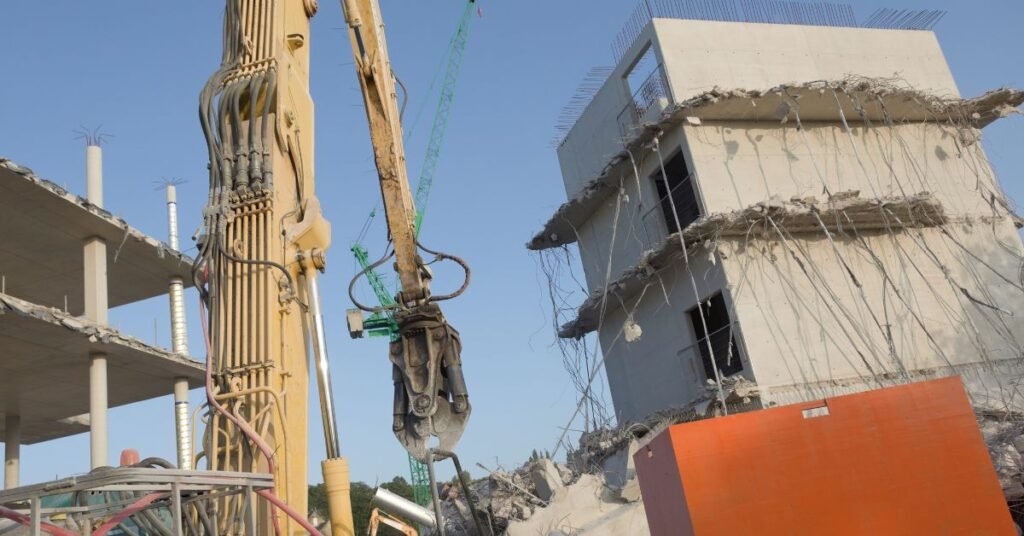
High-reach demolition excavators, designed specifically for dismantling tall structures, play a pivotal role in urban environments where space constraints and safety considerations are paramount. These machines possess high reach capabilities, enabling operators to safely access and dismantle multi-story buildings without compromising surrounding structures or public safety. The design of high-reach excavators often includes extended booms and specialized attachments, allowing for efficient material handling from significant heights.
Demolition safety is a critical aspect of their operation; these excavators are equipped with advanced features that enhance stability and precision during demolition tasks. Operators are trained to use these machines in compliance with safety regulations, minimizing risks associated with debris fall and structural instability. Additionally, high-reach demolition excavators contribute to environmentally responsible demolition practices, as they facilitate controlled dismantling, reducing waste and promoting recycling of materials.
The effectiveness of high-reach demolition excavators is largely attributed to their key features, which enhance operational efficiency and safety. One of the most critical components is the advanced hydraulics system, which provides superior lift and reach capabilities, allowing operators to maneuver with precision at significant heights. This hydraulic technology enables the excavator to manage heavy loads while maintaining stability, even during challenging demolition tasks.
Additionally, high-reach excavators are equipped with specialized demolition attachments, such as shears, crushers, and grapples, designed to optimize the demolition process. These attachments are engineered for specific materials and demolition techniques, ensuring effective material removal and minimizing downtime. The combination of advanced hydraulics and tailored demolition attachments makes high-reach excavators indispensable for large-scale demolition projects, facilitating complex operations while prioritizing safety and efficiency on construction sites.
High-reach excavators offer significant advantages in demolition projects, primarily through their enhanced reach capabilities, which allow operators to access elevated structures safely and efficiently. These models are also equipped with improved safety features that minimize risks associated with working at heights, ensuring both operator and site safety. Consequently, high-reach excavators are increasingly favored for tasks involving multi-story buildings and complex demolition scenarios.
Enhanced reach capabilities present a significant advantage in the domain of demolition excavators, particularly for high-reach models designed to tackle tall structures and complex dismantling tasks. These models offer superior performance due to their enhanced stability features and improved hydraulic systems, which allow for precise operation at great heights.
The emotional impact of these capabilities includes:
Numerous advancements in safety features have been integrated into high-reach demolition excavators, greatly enhancing operator protection during complex dismantling operations. These machines are designed to meet stringent safety standards, incorporating features such as advanced stability systems and enhanced visibility to minimize the risk of accidents. High-reach models often include reinforced cabs, operator detection systems, and emergency shut-off mechanisms, ensuring immediate response in hazardous situations. In addition, effective operator training is essential, enabling personnel to understand and utilize these safety features thoroughly. As a result, high-reach demolition excavators not only improve operational efficiency but also create a safer working environment. This commitment to safety underscores the evolution of demolition technology, prioritizing the well-being of operators and surrounding personnel.
While many demolition projects require versatile machinery, high-reach excavators are specifically designed for tasks that involve significant vertical demolition. Their high reach capabilities make them invaluable for safely dismantling tall structures, ensuring that demolition safety is prioritized.
Ideal applications for high-reach excavators include:
In each of these scenarios, high-reach excavators provide a strategic advantage, allowing operators to effectively manage risks associated with height and structural integrity. Their design not only enhances efficiency but also upholds safety standards essential in demolition projects.
Standard demolition excavators are characterized by their robust design, which includes reinforced structures and specialized attachments for various demolition tasks. These machines are commonly employed in urban environments for building deconstruction, site clearance, and material handling, but they also face operational limitations due to size and maneuverability. Understanding their key features, typical applications, and constraints is essential for maximizing efficiency in demolition projects.
Demolition excavators are specialized machines designed to efficiently dismantle structures, showcasing a range of key features that enhance their operational capabilities. Understanding these features is essential for effective excavator maintenance and operator training.
These features collectively guarantee that standard demolition excavators deliver peak performance in demolition projects.
The capabilities of demolition excavators extend into a variety of applications within the construction and demolition sectors. Standard demolition excavators are primarily utilized in the dismantling of structures, where precise demolition techniques are vital for safety and efficiency. They are effective in tearing down walls, removing foundations, and clearing debris from sites. Additionally, these machines are employed in urban environments for selective demolition, enabling the preservation of adjacent structures. Routine equipment maintenance is essential to guarantee peak performance and longevity, as the demanding nature of demolition work can lead to wear and tear. Operators must adhere to maintenance schedules to minimize downtime and maintain operational effectiveness, thereby enhancing the overall productivity of demolition projects.
Operating within the confines of specific limitations, standard demolition excavators face challenges that can affect their performance and efficiency. These operational constraints greatly influence machine capabilities and can impact project timelines and costs.
Understanding these limitations is essential for operators and project managers, as they navigate the complexities of demolition tasks and optimize the use of standard excavators in various environments.
Standard excavators are essential machines in construction and excavation projects, characterized by several key features that enhance their functionality and efficiency. These machines typically include robust hydraulic systems, which allow for precise control and significant lifting capabilities, making them suitable for various tasks. The standard excavator specifications often feature a powerful engine, ensuring peak performance even in challenging conditions.
Moreover, the ergonomic design of the operator’s cabin enhances comfort and visibility, reducing operator fatigue during extended use. Standard models also come equipped with a variety of attachments, such as buckets and hydraulic hammers, providing versatility for different applications. The standard model benefits include a balance between maneuverability and stability, allowing for effective operation in tight spaces while maintaining performance on uneven terrain. Overall, these features contribute to the effectiveness and reliability of standard excavators in diverse construction environments.
While various excavator models exist, standard models provide distinct advantages that enhance operational efficiency and overall project execution. The efficiency comparison between standard models and other types showcases their reliability and versatility in various demolition tasks.
Key advantages include:
These standard model advantages contribute considerably to minimizing downtime and maximizing productivity on job sites. By providing a balanced combination of power and precision, standard excavators are often the preferred choice for contractors aiming to achieve ideal results in demolition projects.
The versatility of standard excavators makes them highly suitable for a variety of demolition tasks across different environments. These machines excel in standard excavator applications such as dismantling residential structures, clearing debris, and performing site preparation. Their robust design and powerful hydraulics enable efficient material handling, which is vital in both urban and rural settings.
Standard model benefits include a balanced combination of reach, power, and maneuverability, allowing operators to effectively navigate confined spaces or uneven terrain. Additionally, standard excavators can be outfitted with various attachments, enhancing their functionality for specific tasks like concrete breaking or material sorting.
In addition to their adaptability in different demolition scenarios, standard excavators provide reliable performance that enhances productivity and safety on the job site. Overall, these machines serve as essential tools in the demolition industry, delivering effective solutions for a range of applications.
Mini demolition excavators are compact yet powerful machines designed specifically for demolition tasks in tight spaces and urban environments. Their unique size allows operators to maneuver easily while maintaining efficiency.
The benefits of mini excavators include:
However, mini excavators also have limitations. Their smaller size can restrict lifting capacity and reach, making them unsuitable for larger-scale demolition projects. Understanding both the benefits and limitations is essential for contractors choosing the right equipment for specific demolition tasks.
Compact yet versatile, mini excavators are equipped with several key features that enhance their performance in demolition tasks. One prominent feature is their reduced overall size, allowing access to confined spaces where larger machines cannot operate. Mini excavator features often include a powerful hydraulic system, enabling efficient digging, lifting, and material handling. Additionally, many models offer adjustable tracks, providing stability on uneven terrain and enhancing maneuverability.
Another significant aspect is the interchangeable attachment capability, which allows operators to switch between buckets, hammers, and other tools tailored for specific demolition tasks. Moreover, mini excavators typically feature advanced control systems that enhance precision and operator comfort, resulting in improved productivity.
Mini models of demolition excavators offer significant advantages, particularly in space-constrained environments where their compact design enhances maneuverability. Their cost-effective operation reduces overhead expenses, making them an attractive option for budget-conscious projects. Additionally, the versatility of mini excavators allows them to perform a wide range of tasks, from demolition to landscaping, thereby increasing their utility across various applications.
A growing number of construction projects require equipment that can navigate tight spaces and limited work areas effectively. Mini models of demolition excavators excel in space efficiency, allowing for ideal space utilization and a compact design. Their advantages are particularly pronounced in urban environments or areas with restricted access.
Key benefits include:
Cost-effective operation is a significant advantage of utilizing smaller demolition excavators in various construction projects. Mini models enhance cost efficiency by reducing fuel consumption and maintenance expenses. Their compact size allows for easier transportation and operation in constrained spaces, further contributing to operational savings.
| Factor | Mini Excavators |
|---|---|
| Fuel Consumption | Lower than larger models |
| Maintenance Cost | Reduced parts and labor |
| Transport Expenses | Easier and cheaper to move |
Incorporating mini excavators into demolition projects not only streamlines operations but also maximizes return on investment. Their ability to perform efficiently in tight environments positions them as a practical choice for contractors aiming for budget-friendly solutions.
Utilizing smaller demolition excavators considerably broadens the scope of applications across various construction environments. These mini models are particularly advantageous due to their inherent design, allowing for precise maneuverability in confined spaces. Their versatility enhances numerous demolition techniques while ensuring equipment durability.
The adoption of mini excavators not only optimizes operational efficiency but also minimizes disruption to surrounding areas. Their lightweight construction and robust capabilities make them indispensable in modern demolition projects, catering to diverse needs while maintaining high performance standards.
Although larger excavators are often preferred for heavy-duty tasks, mini excavators have carved out a niche for themselves in various applications due to their versatility and compact size. Their ability to maneuver in tight spaces makes them ideal for urban environments and smaller job sites.
| Application | Mini Excavator Benefits | Compact Demolition Advantages |
|---|---|---|
| Residential Renovations | Access to confined areas | Minimal disruption to surroundings |
| Landscaping Projects | Precision in delicate tasks | Reduced soil disturbance |
| Utility Work | Efficient trench digging | Easy transport between sites |
| Light Demolition | Cost-effective for small jobs | Reduced noise and vibration |
| Site Preparation | Quick setup and operation | Less site footprint |
Ultimately, mini excavators provide significant advantages in specific demolition tasks, making them a valuable option for contractors focused on efficiency and effectiveness.
When selecting a demolition excavator, several critical factors must be considered to guarantee peak performance and efficiency for the specific project at hand. The conditions of the demolition site play an essential role in determining the appropriate machinery. Additionally, careful equipment budget considerations can influence the decision-making process.
Key factors to evaluate include: