
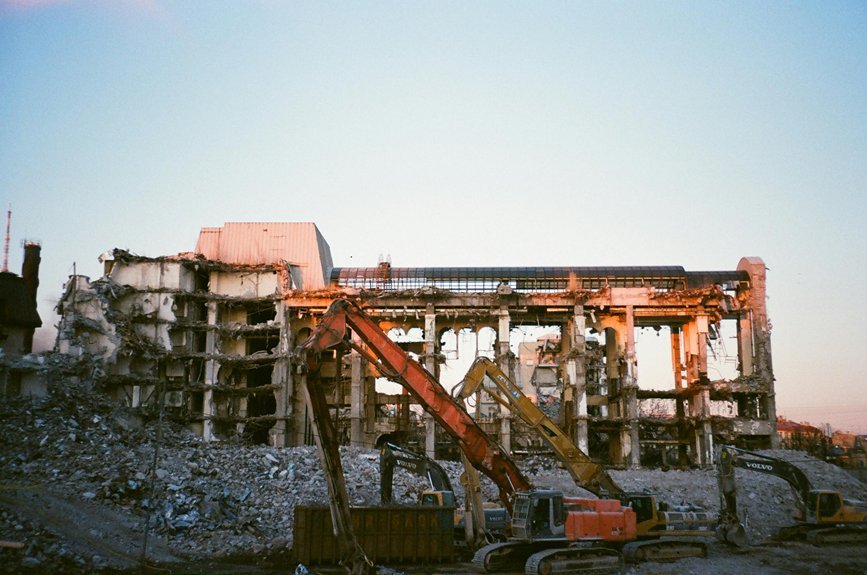
The choice between explosive and mechanical demolition methods presents distinct considerations for project managers. Explosive demolition offers rapid site clearance, while mechanical demolition emphasizes safety and precision. Each approach has its own set of advantages and drawbacks. Understanding these differences is essential for selecting the most appropriate method for a given project. Factors such as safety, environmental impact, and urban context further complicate this decision-making process. What are the implications of these factors on project outcomes?
Overview of Explosive Demolition
Explosive demolition represents a highly specialized technique employed in the dismantling of structures, utilizing controlled explosives to achieve rapid and efficient destruction. This method relies on various explosive techniques, including sequential blasting and pre-weakening, to guarantee targeted outcomes while minimizing unintended damage to surrounding areas. The precise timing and placement of explosives are critical, as they dictate the structural failure pattern and debris trajectory.
Demolition safety is paramount in explosive demolition projects. Rigorous planning and risk assessment protocols are implemented to safeguard workers and the public. Controlled evacuation zones are established, and protective barriers are erected to mitigate the impact of flying debris. Additionally, experts conduct thorough site evaluations to identify potential hazards, guaranteeing that all safety measures are adhered to during the demolition process. Overall, explosive demolition offers a swift alternative to traditional methods, provided that safety and technical precision are prioritized throughout the operation.
Overview of Mechanical Demolition
Mechanical demolition is a widely utilized method for dismantling structures, relying on heavy machinery and equipment to achieve systematic removal of building components. This approach is characterized by its use of various mechanical techniques that prioritize safety and environmental considerations.
Key aspects of mechanical demolition include:
- Excavators: Versatile machines equipped with attachments for cutting, crushing, and lifting materials.
- Bulldozers: Heavy-duty equipment designed to push large volumes of debris and clear sites efficiently.
- Crushers: Machines specifically engineered for breaking down concrete and masonry into manageable sizes.
- High-reach excavators: Specialized equipment for dismantling tall structures, allowing for precision and controlled demolition.
Key Advantages of Explosive Demolition
Explosive demolition offers significant advantages, particularly regarding project completion speed. This method enables rapid dismantling of structures, minimizing downtime and facilitating quicker site redevelopment. Additionally, when executed with precision, explosive techniques can result in a reduced environmental impact compared to traditional mechanical methods, as they often generate less debris and noise.
Speedy Project Completion
Although various demolition techniques exist, explosive demolition stands out for its remarkable ability to expedite project completion. This method greatly enhances project timelines due to its speed and effectiveness, allowing for rapid site clearance. Key efficiency factors include:
- Reduced Downtime: Quick execution minimizes disruptions to adjacent operations.
- Streamlined Process: Less preparatory work is required compared to mechanical methods.
- Immediate Site Availability: The aftermath of explosive demolition facilitates prompt redevelopment.
- Cost-Effectiveness: Lower labor costs and expedited schedules can lead to budget savings.
Thus, explosive demolition is often the preferred choice for projects where time is of the essence, ensuring that subsequent phases can commence without unnecessary delays.
Reduced Environmental Impact
The choice of demolition method can greatly influence environmental outcomes, and explosive demolition offers several advantages in this regard. Compared to mechanical methods, explosive demolition typically results in a more controlled and compact debris pattern, facilitating improved waste management. This method reduces the volume of rubble generated, allowing for easier sorting and recycling of materials, thereby supporting sustainable practices. Additionally, the rapid nature of explosive demolition minimizes the duration of site disturbance, which can reduce emissions and noise pollution associated with prolonged construction activities. Furthermore, when executed properly, the technique can lower the risk of collateral damage to surrounding environments, further enhancing its appeal as a more environmentally responsible demolition approach. Ultimately, explosive demolition aligns with modern sustainability goals.
Key Advantages of Mechanical Demolition
Mechanical demolition offers distinct advantages, particularly regarding safety and operational precision. The use of heavy machinery minimizes the risk of accidents associated with unpredictable structural collapses, thereby enhancing safety for workers and surrounding environments. Additionally, the controlled nature of mechanical techniques allows for targeted dismantling, ensuring that specific structures can be removed with high accuracy and minimal collateral damage.
Safety Considerations
While various demolition methods present unique safety challenges, mechanical demolition stands out for its ability to minimize risks associated with structural collapse and worker exposure. This method utilizes heavy machinery and systematic procedures that promote a safer work environment.
Key safety considerations include:
- Thorough risk assessment to identify potential hazards before commencing work.
- Implementation of stringent safety protocols to protect workers and surrounding areas.
- Reduced likelihood of airborne debris and noise pollution compared to explosive methods.
- Enhanced control over the demolition process, allowing for immediate response to unforeseen challenges.
These factors contribute to mechanical demolition’s reputation as a safer alternative, ensuring that the welfare of workers and the public remains a priority throughout the project lifecycle.
Precision and Control
Utilizing mechanical demolition techniques greatly enhances precision and control during the dismantling process. This method employs precision techniques that allow operators to target specific structural elements, minimizing collateral damage to surrounding areas. Equipment such as excavators and hydraulic shears are designed for fine-tuned operations, enabling the careful removal of materials without excessive force. Control measures, including the use of advanced monitoring systems, guarantee that the demolition process remains safe and efficient. Operators can adjust their approach based on real-time data, thereby increasing the accuracy of their work. Overall, mechanical demolition’s emphasis on precision and control not only improves operational outcomes but also considerably reduces the risk associated with conventional demolition methods.
Safety Considerations in Explosive Demolition
Safety considerations in explosive demolition are paramount, as the inherent risks associated with controlled detonations necessitate meticulous planning and execution. A thorough risk evaluation is vital to identify potential hazards and establish safety protocols to protect personnel and surrounding structures. The establishment of a clearly defined blast zone is essential to guarantee that unauthorized individuals are kept at a safe distance during detonations.
Key safety considerations include:
- Proper training: Making sure all personnel are trained in explosive handling and emergency procedures.
- Site evaluation: Conducting thorough inspections of the demolition site to identify structural vulnerabilities and nearby sensitive areas.
- Communication: Implementing clear communication channels among the demolition team and emergency services.
- Monitoring conditions: Continuously evaluating weather and environmental factors that may impact the safety of the demolition operation.
Ultimately, adherence to these safety measures can meaningfully mitigate the risks associated with explosive demolition.
Safety Considerations in Mechanical Demolition
Mechanical demolition presents its own set of safety considerations that are essential for ensuring the well-being of workers and the integrity of the surrounding environment. Effective safety protocols must be established to mitigate potential hazards associated with heavy machinery, falling debris, and structural instability. Prior to the commencement of any demolition project, an extensive risk assessment is essential to identify and evaluate potential risks, and in this way facilitating the development of targeted safety measures.
The use of personal protective equipment (PPE) is mandatory, including hard hats, safety glasses, and steel-toed boots, to shield workers from injury. Additionally, proper training on machinery operation and emergency response procedures is crucial. Clear communication among team members and the establishment of exclusion zones around the demolition site further enhance safety. By adhering to these safety protocols and conducting thorough risk assessments, mechanical demolition can be executed with a focus on minimizing hazards and protecting all involved parties.
Environmental Impact of Both Methods
The environmental impact of demolition methods, whether mechanical or alternative approaches, warrants careful examination due to the significant consequences they can impose on surrounding ecosystems. Each method presents unique challenges and opportunities for sustainability practices and waste management.
- Mechanical demolition often results in lower emissions and reduced noise pollution.
- Explosive demolition can lead to immediate debris dispersal, complicating waste management efforts.
- Both methods generate significant waste, necessitating effective recycling and disposal strategies.
- Mechanical methods typically enable better control of hazardous materials, promoting safer environmental outcomes.
Understanding these impacts is essential for stakeholders aiming to minimize ecological disruption. The choice of demolition method directly influences the efficiency of waste management systems and the implementation of sustainability practices, ultimately shaping the environmental footprint of construction activities. A thorough evaluation can guide decision-making to align with contemporary environmental standards, fostering a balance between development and ecological preservation.
Choosing the Right Method for Your Project
When determining the most suitable demolition method for a project, various factors must be meticulously assessed to guarantee ideal outcomes. The decision between explosive and mechanical demolition hinges on a detailed cost analysis, which evaluates the overall expenses associated with each method, including labor, equipment, and safety measures. Additionally, the project timeline plays a critical role; explosive demolition typically offers a rapid completion time, while mechanical demolition may extend the duration due to its incremental approach. Site-specific conditions, such as proximity to occupied buildings and environmental regulations, further influence the choice. Stakeholders must also consider the potential for unforeseen complications, which can impact both costs and timelines. Ultimately, a thorough evaluation of these factors will lead to an informed decision that aligns with project goals, ensuring efficiency and safety throughout the demolition process.
Conclusion
To summarize, the choice between explosive and mechanical demolition hinges on project requirements, safety, and environmental considerations. Significantly, explosive demolition can complete a project in a fraction of the time, with some sites being cleared within minutes, compared to days or weeks for mechanical methods. However, the safety of nearby individuals remains paramount; statistically, over 1,000 injuries occur annually in the demolition industry, underscoring the critical need for careful method selection to safeguard lives and communities.